

The Hidden Risk in Reinsurance Contracts: Wording Matters
Catégorie : Articles
A single word.
That is sometimes all it takes to change the outcome of a reinsurance claim.
I am Janita Chellemben, recently joined Ellgeo Re as a Reinsurance Analyst specialising in contractual documentation.
Though early in this role, one thing has become clear: wordings can make or break a reinsurance claim, especially when tested in real-life situations.
In reinsurance, we often focus on the numbers, limits, premiums, attachment points, and layers. That is the visible architecture of every deal.
Yet the real risk often hides in the literature.
We often fail to realise that a misplaced word, an ambiguous clause, or a silent assumption can turn what appears to be a straightforward claim into months, if not years, of interpretation and debate. For example, consider how often the term “event” is used.
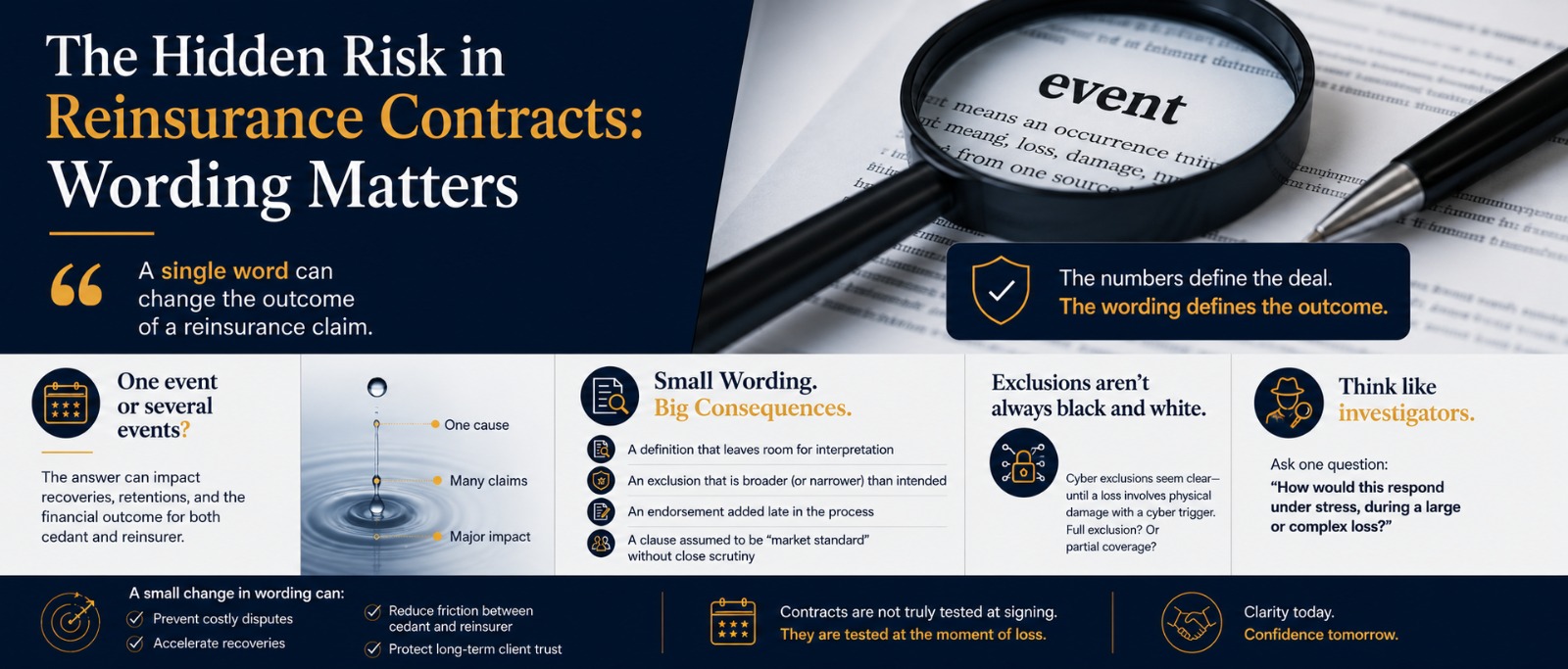
In a loss scenario involving multiple claims, say, widespread damage arising from a single underlying cause, the question quickly becomes: is this one event or several events? The answer can significantly impact recoveries, retentions, and ultimately the financial outcome for both cedant and reinsurer.
Back-to-back intent may seem clear during placement, but a contract is not truly tested at signing; rather, it is tested at the moment of loss.
And at that point, absolute clarity becomes essential.
Surprisingly, the issues are not always complex.
More often than not, disputes arise from the simplest elements:
- a definition that leaves room for interpretation
- an exclusion that is broader (or narrower) than intended
- an endorsement added late in the process
- a clause assumed to be “market standard” without close scrutiny
Another example often seen in practice is exclusions.
A cyber exclusion, for instance, may appear clear at first glance but when a loss involves both physical damage and a cyber trigger, questions arise: does the exclusion fully apply, or is there partial coverage? These grey areas are where interpretation begins and where delays and disagreements can follow.
In the reinsurance world, where recoveries directly affect capital management, reserving certainty, and client relationships, wording precision is not a technicality. It is a core risk management discipline.
We speak often about underwriting discipline, accumulation control, and exposure management yet contractual discipline rarely gets the attention it deserves.
What if we approached reinsurance wordings not only as lawyers, but as detectives?
Reading each clause with one central question in mind:
How would this respond under stress during a large or complex loss?
Because in reality, a small tweak in language can:
- prevent costly disputes
- accelerate recoveries
- reduce friction between cedant and reinsurer
- and ultimately protect long-term client trust
Clarity is not about making contracts longer.
It is about making intent unmistakable.
In a market where partnerships matter and reputations are built over decades, wordings are more than documentation. They are the foundation of confidence between parties.
The numbers define the deal.
The wording defines the outcome.
So, I find myself asking: Are we paying enough attention?

Comments are closed here.